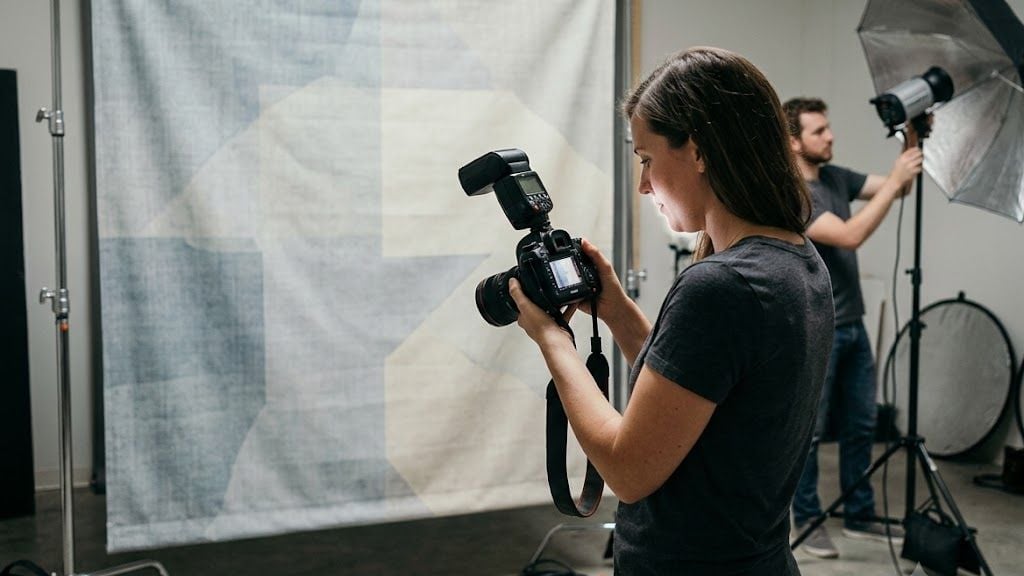
Matte-finish fabric backdrops from Big Visual Group in Nashville eliminate flash glare, unlike glossy vinyl alternatives. Fabric’s woven texture diffuses light evenly, preventing hotspots and reflections during photo shoots. Big Visual Group’s production and fabrication team ensures every printed backdrop maintains a non-reflective surface suited for professional flash photography setups.
Custom printed fabric backdrops minimize glare far better than vinyl or PVC alternatives. Fabric’s matte, light-absorbing surface diffuses camera flash instead of bouncing it back, unlike glossy vinyl banners. We supply TRIGA® Go tensioned textile displays. Printed fabric drapes engineered for clean, even photography under flash and stage lighting alike.
Do fabric backdrops cause flash glare?
Fabric backdrops resist flash glare far better than glossy vinyl surfaces. Woven material scatters light instead of bouncing it straight back into the lens. On-camera and studio strobes render clean, shadow-free images. We build our custom printed fabric backdrops specifically around this behavior. Event photographers depend on predictable, glare-free results shot after shot.
Vinyl’s slick coating reflects light directly at the camera, creating hotspots that ruin an otherwise strong shot. Fabric’s matte, textured weave diffuses that same light across the surface. The difference shows up immediately in flash-heavy environments like red carpets, step-and-repeats, and trade show photo stations.
What makes a backdrop truly glare-free?
A true glare-free photo wall depends on three things: material texture, print finish, and how the drape hangs. We manufacture backdrops that hang apartment and taut, travel without creasing, and hold up under repeated setup and teardown. That combination keeps the surface working with the room’s lighting plan rather than fighting it.
Are fabric backdrops better than vinyl for event photography?
Fabric outperforms vinyl for most photography-driven events. Vinyl still suits short-term signage where a wipe-clean surface matters more than image quality. For flash-forward settings, we recommend fabric every time.
As a Nashville-based sign and print company, we build non-reflective event banners alongside a broader catalog of print products, signs, vehicle wraps, signage display systems, trade show displays, and design services. That range lets event planners, photographers, and trade show exhibitors source a matched, camera-ready backdrop system from a single supplier rather than piecing solutions together.
Why does vinyl reflect more light than fabric?
Nonporous plastic explains the glare problem. Vinyl backdrops are manufactured from a flexible, nonporous material, and most vinyl finishes carry a shiny surface that bounces direct light straight back into the camera lens. Fabric behaves differently because its woven texture absorbs and diffuses light rather than reflecting it in a single hard beam. That difference matters most when strobes, ring lights, or stage spots hit the backdrop at close range.
Does vinyl ever make sense for events?
Vinyl still earns its place in certain settings. When a bold logo, a wipe-clean surface, or a temporary outdoor display is the priority, vinyl delivers durability and easy maintenance at a lower upfront cost. We recommend it for signage that will not sit directly under studio lighting.
What makes fabric better for flash photography?
Woven fabric scatters incoming light across thousands of fiber strands instead of one glossy plane. This produces non-reflective event banners that hold color. Detail even under harsh flash, giving photographers a glare-free photo wall without retouching hot spots in post-production.
| Material | Surface behavior | Best use case |
|---|---|---|
| Vinyl | Shiny, reflects light directly | Short-term signage, outdoor durability |
| Fabric | Woven, diffuses light | Photo backdrops, stage lighting |
Our team fabricates custom printed fabric backdrops in-house at our 40,000-square-foot print production and sign fabrication facility, alongside signs, vehicle wraps, display systems, and trade show hardware. Having every material option under one roof lets clients compare vinyl. Fabric side by side before committing to a production run.
What makes a photo wall truly glare-free?
Material choice determines nearly everything about a glare-free result. A glare-free photo wall succeeds or fails based on what the surface is made of, not the artwork printed on it. We build every backdrop around that principle first, because no amount of clever lighting fixes a reflective surface once flash photography enters the picture.
Why does fabric outperform vinyl under camera flash?
Fabric absorbs light instead of bouncing it back into the lens. Polyester and cotton canvas rank as the top material choices for stopping flash glare, which is why we default to custom printed fabric backdrops for step-and-repeat walls, press events, and branded photo stations. Vinyl, by contrast, carries a slick coating that scatters light directly toward the camera, producing hot spots and washed-out logos in finished photos.
How do we translate that into a finished install?
We do not simply hand over a roll of fabric. Our graphic design team meets with clients first to understand the marketing goals and display requirements behind the project. From there, we recommend a layout and material suited to the venue’s lighting and camera positions.
That guidance carries through four stages of our process:
- Consultation and management — defining goals, venue conditions, and flash exposure
- Concepting and design — building artwork sized for a non-reflective surface
- Production and fabrication — printing on fabric engineered to minimize glare
- Installation and fulfillment — delivering a wall ready for continuous photography
This structure keeps non-reflective event banners consistent from concept through the final install. Every photo taken against the backdrop looks clean, sharp, and professional.
How do non-reflective banners perform at trade shows?
Non-reflective banners hold up well under the harsh overhead lighting common at convention centers. Non-reflective event banners avoid the hot spots. Glare that vinyl often throws back at cameras, keeping booth graphics readable from every angle. We build ours around TRIGA® Go, a tensioned textile display system engineered for fast setup of stands, walls, towers, totems, and counters.
The performance comes down to how the fabric sits on the frame. Digitally printed textile panels stretch smoothly. Tightly across TRIGA®’s aluminum structure, eliminating the sagging or bubbling that creates glare points on rigid vinyl signs. The result is a clean, consistent surface that photographs well under booth lighting and camera flash alike.
Does the frame size matter for setup speed?
It does, and we stock the 8-foot-high configuration specifically to cut turnaround time. Exhibitors working against tight show deadlines benefit from shorter shipping and production windows. The size stays on hand rather than on order.
Who installs these systems at the venue?
Our installation team carries 3M certification, which matters when a booth backdrop needs to look flawless on day one. Certified installers mount fabric panels without wrinkles or shifting, so the surface stays taut and glare-free throughout the show.
For exhibitors weighing materials, the comparison is straightforward:
| Factor | Tensioned Fabric (TRIGA®) | Standard Vinyl |
|---|---|---|
| Glare under booth lighting | Minimal | Noticeable |
| Setup speed | Fast, modular frame | Varies by hardware |
| Surface finish | Smooth, tight | Prone to sag/wrinkle |
| Turnaround | Faster (stocked 8-ft config) | Depends on order |
Booths built on this system consistently produce a glare-free photo wall, which matters when attendees and press are photographing your brand all day.
Which backdrop material should you choose?
Fabric wins for most photography-driven events; vinyl still earns its place for short-term, wipe-clean signage. Weight and finish determine performance more than brand or color choice. Our teams weigh both factors before recommending a material for any project.
Fabric weight controls opacity. Heavier fabric produces a denser print surface, cutting down on see-through effects and limiting light bleed that disrupts flash photography. That density matters most for custom printed fabric backdrops used behind step-and-repeat walls. The camera flashes fire repeatedly throughout an event.
Does fabric really look better in photos than vinyl?
Fabric drapes fold with less bulk than vinyl sheeting, which keeps setup wrinkle-free and travel-friendly. Coverage reads softer on camera, and the finished result looks less staged than a stretched vinyl panel. For exhibitors photographing guests all evening, that softer look reduces retouching time later.
What makes an event banner glare-free?
A matte-finish fabric surface scatters light rather than reflecting it directly into the lens. Vinyl’s glossy coating, by contrast, bounces the flash straight back at the camera. Choosing non-reflective event banners protects headshots, brand photography, and video coverage from harsh hot spots.
| Priority | Better Choice |
|---|---|
| Flash photography, portraits | Fabric |
| Short-term signage, wipe-clean surface | Vinyl |
| Travel and repeated setup | Fabric |
We manage every backdrop decision from consultation through installation and fulfillment, including concepting, design, and fabrication. Our sales consultants are available Monday through Friday, 8:30 a.m. to 5:00 p.m., to discuss material options and help plan a glare-free photo wall suited to your venue.
Frequently Asked Questions
Do custom printed fabric backdrops cause glare in flash photography?
No. Fabric’s matte, woven texture diffuses camera flash instead of bouncing it back, unlike glossy vinyl, which reflects light directly into the lens and creates hotspots.
Why does vinyl produce more glare than fabric backdrops?
Vinyl is a nonporous plastic with a shiny finish that reflects direct light straight back at the camera. Fabric’s woven surface absorbs and diffuses that same light.
Should event planners choose fabric or vinyl for photography-heavy events?
Fabric performs best for flash-forward settings like red carpets and trade show photo stations. Vinyl still suits short-term signage where a wipe-clean surface matters more than image quality.
Conclusion
Custom printed fabric backdrops resist flash glare because their woven, matte surface diffuses light, while vinyl’s shiny, nonporous surface reflects it straight into the camera lens. Fabric delivers the glare-free result photography-driven events need; vinyl remains a practical choice for short-term, wipe-clean signage where image quality under flash matters less. Big Visual Group builds that fabric performance into every custom printed fabric backdrop and TRIGA® Go tensioned textile display, guided by our consultation, design, production, and installation process. If you’re planning a photo wall, trade show booth, or step-and-repeat that needs to hold up under flash, schedule a consultation with our team and we’ll help you choose the right material for your venue.