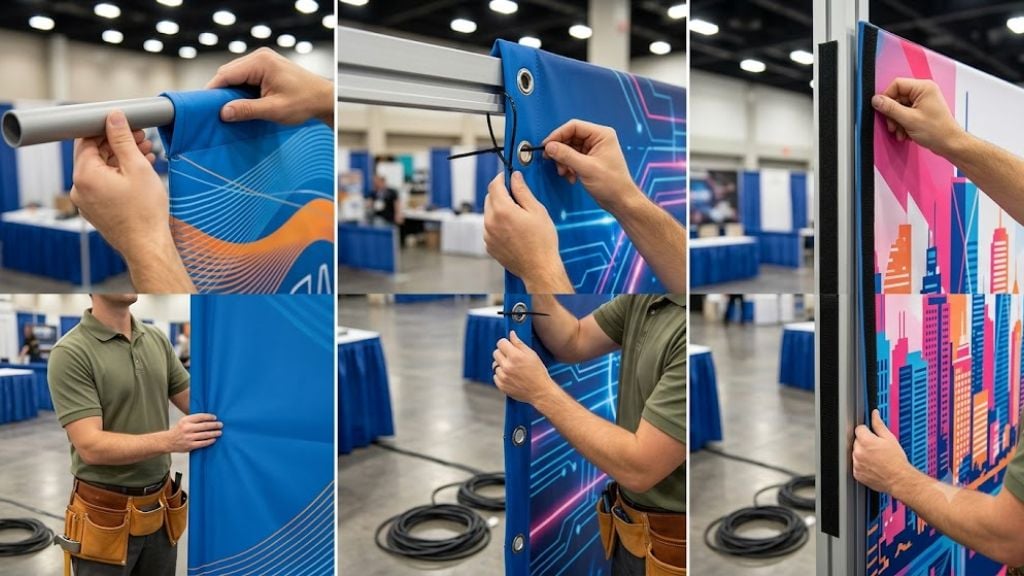
Pole pockets deliver the cleanest tension-free hang for step-and-repeat backdrops, grommets suit lightweight banners needing zip-tie or S-hook mounting, and velcro attaches fabric to portable frame systems seamlessly. Big Visual Group’s Nashville team fabricates all three finishes for trade show displays and signage.
Pole pockets, grommets, and Velcro each suit different backdrop needs: pole pockets create clean, hardware-free lines by sliding a pipe through a sewn sleeve, grommets offer reinforced holes for zip ties. S-hooks across trade show and stage settings. Velcro attaches lightweight panels to systems like TRIGA® Go displays for fast, tool-free setup.
What Do You Need Before Mounting a Fabric Backdrop?
Three elements determine success: a finishing plan, qualified installers, and production capacity that matches the size of the job. Skipping any one of these steps risks a crooked hang, damaged fabric, or a backdrop that fails mid-event in front of clients, guests, or an audience. We treat mounting as a planning problem first and a physical task second.
Before production begins, our design and consultation team maps out event banner finishing options with each client. Pole pockets, grommets, or tension fabric display hardware — based on venue structure and setup speed. This upfront planning prevents costly rework once a custom printed fabric backdrops order is already printed and cut.
Who should install a large-format fabric backdrop?
Large-format installations belong in the hands of certified professionals, not general labor. Our installers hold 3M certification, a credential that confirms proper technique for securing large-format materials without stress tears or seam separation. That certification matters most on tall stage walls, step-and-repeat setups, and multi-panel trade show displays.
Can production and finishing happen in one facility?
Yes. We fabricate backdrops and hardware inside a single 40,000-square-foot print production and sign fabrication facility, which keeps finishing decisions and manufacturing under one roof. This setup reduces handoff delays between design approval and final output.
To prepare for a mounting project, we recommend the following:
- Schedule a consultation to review venue dimensions and structure type.
- Confirm the finishing method — grommets, pole pockets, or tensioned hardware.
- Book installation with certified personnel ahead of the event date.
Consultations run Monday through Friday, 8:30 a.m. to 5:00 p.m., giving planning teams a reliable window to lock in details before deadlines tighten.
How Do Pole Pockets Mount a Fabric Backdrop?
Sewn or heat-sealed loops at the top of a backdrop create the mounting channel for pole pockets. A pole or rod slides through this loop, and sometimes a matching pocket at the bottom stabilizes the panel further. We build this finishing method into many of our custom printed fabric backdrops. It delivers a clean mount without visible hardware.
Follow these steps when we install a pole-pocket backdrop for your event:
- Confirm the pole diameter matches the pocket width before shipment.
- Feed the pole through the top loop, working from one edge to the other.
- Secure the pole to your stand, truss, or frame.
- Repeat the process at the bottom pocket, if your backdrop includes one, to lock the fabric taut and prevent shifting.
Why Do Photographers Prefer Pole Pockets Over Other Event Banner Finishing Options?
Photography and studio backdrops favor pole pockets because the rod disappears inside the fabric channel. That seamless, smooth look keeps the frame out of frame, literally, so nothing distracts from the subject. Among the various event banner finishing options we fabricate, this concealed-hardware approach remains the standard choice for studio work.
Are Pole Pockets Used for Trade Show Displays?
Step and repeat banners rely on pole pockets, or similar concealment methods, to hide the supporting structure behind them. Exhibitors want branded imagery front and center, not aluminum poles or clamps. As part of our exhibits and trade show display services, we pair pole-pocket construction with tension fabric display hardware to give exhibitors a polished, frame-free presentation on the show floor.
When Should You Choose Grommets Instead?
Existing structures without a hidden frame call for grommets. Reinforced metal rings, punched through pre-cut holes and often backed by 1-inch folded hems, give custom printed fabric backdrops the strength to hang securely from hooks, cables, or nails already in place at a venue.
We recommend grommets whenever a backdrop must attach to a structure that cannot be concealed. Trade show booths with exposed pipe-and-drape, stage rigging at a concert venue, or a wall-mounted display at a corporate lobby all fall into this category. Pole pockets work best when a frame needs to disappear behind the graphic. Grommets work best when the mounting hardware is already visible and simply needs a strong attachment point.
Are grommets better for events with changing setups?
Yes. Band managers and event planners who move between venues benefit most from grommets. Because the rings adapt to whatever hanging hardware is on site, from bungee cords to zip ties to S-hooks, a single backdrop travels between locations without requiring a matched frame system every time.
Our production team at Big Visual Group builds grommets. Hems into our broader lineup of event banner finishing options, alongside pole pockets and other mounting styles suited for tension fabric display hardware. We fabricate each finish in-house, so trade show exhibitors and photographers can match the hanging method to their exact venue conditions rather than settling for a one-size-fits-all approach.
Consider grommets when:
- The backdrop attaches directly to an existing pipe, cable, or wall fixture
- The frame or structure cannot be hidden behind the graphic
- The event moves between multiple venues with different hanging hardware
- Flexibility matters more than a fully finished, frame-free look
How Does Tension Fabric Hardware Compare?
Tension fabric display hardware stands apart through frame engineering, not fabric alone. TRIGA® Go, which we stock and install, delivers a tensioned textile system built for stands, walls, towers, totems, and counters. Aluminum construction keeps every configuration light enough for one-person handling yet rigid enough for repeated trade show cycles.
What makes the frame itself different?
The aluminum structure is the core advantage. It is durable, lightweight, and modular, so a single frame family adapts to various-sized textile prints without custom fabrication. Assembly requires no tools, and each system arrives with a carrying bag designed for efficient transport between venues. We consider this modularity essential for exhibitors managing multiple show configurations under one budget.
Does the fabric look as sharp as rigid signage?
Digitally printed textile fabric lays smoothly and tightly across the frame, producing a clean, high-impact visual comparable to hard-panel displays. Because the print stretches taut rather than sitting loose, wrinkles and sagging that plague banner-style backdrops disappear.
We stock the 8-foot high configuration specifically to shorten turnaround and shipping time for clients working against tight event deadlines.
| Feature | Benefit for Exhibitors |
|---|---|
| Aluminum modular frame | Fits multiple print sizes without new hardware |
| Tool-less assembly | Faster load-in and breakdown at events |
| Included carrying bag | Simplifies transport between shows |
| 8-foot stocked configuration | Reduces production and shipping delays |
| Tensioned fabric surface | Delivers a smooth, wrinkle-free display |
For event planners and trade show teams comparing hardware options, this combination of speed, durability, and visual quality separates tension fabric systems from traditional pop-up alternatives.
What Mounting Mistakes Should You Avoid?
Weak mounting decisions cost more than they save. Backdrops selected without weighing installation ease, stability, and venue conditions lose their crisp appearance fast, and durability suffers right along with it. We build every recommendation around how the piece will actually be used on-site, not just how it looks in a mockup.
Does the hanging method really affect how the backdrop performs?
Yes. The method chosen determines whether a custom printed fabric backdrop stays taut. Wrinkle-free through a full event day or sags by mid-afternoon. Overall effectiveness hinges on this decision as much as the print quality itself.
What’s the biggest setup mistake exhibitors make?
Skipping professional guidance ranks among the costliest errors we see. Our installers hold 3M certification, which keeps mounting accurate and prevents damage during hanging. Common mistakes we help clients avoid include:
- Selecting event banner finishing options without checking venue rigging or frame compatibility
- Assuming all tension fabric display hardware fits every backdrop size
- Handling installation without trained support, risking tears or uneven tension
- Waiting until event day to arrange fulfillment logistics
We provide consultation and management, design, production, and installation and fulfillment services under one roof. That structure closes the gap between ordering a backdrop and setting it up correctly. Exhibitors avoid last-minute scrambling and delayed setups on show day.
Frequently Asked Questions
What is the main difference between pole pockets and grommets?
Pole pockets create clean, hardware-free lines by sliding a pole through a sewn sleeve. Grommets add reinforced metal eyelets around the fabric edges for hanging with zip ties or S-hooks on various support systems.
When does Velcro work best for fabric backdrops?
Velcro attaches lightweight panels to systems like TRIGA® Go displays, offering quick-change capability for fast, tool-free setup during multi-event productions where backdrops swap rapidly.
Who installs large-format fabric backdrops at Big Visual Group?
Certified installers handle large-format installations. Big Visual Group’s team holds 3M certification, confirming proper technique for securing materials without stress tears or seam separation on tall stage walls and multi-panel displays.
Conclusion
Choosing between pole pockets, grommets, and Velcro comes down to matching each finish’s core attribute to the venue and event type: pole pockets deliver a concealed, hardware-free hang ideal for photography and step-and-repeat displays; grommets provide reinforced, adaptable attachment points for exposed rigging and multi-venue touring; and Velcro enables quick-change, tool-free mounting on frame systems like TRIGA® Go. Tension fabric hardware adds a further layer, pairing an engineered aluminum frame with a taut, wrinkle-free print for a polished finished look. Whichever method fits your setup, the right result still depends on matching the finish to the structure and having it installed correctly. Our design and consultation team can walk through venue specifics and recommend the finishing option that will hold up cleanly through your event. Reach out to us today.